
How regulated businesses connect the way they are governed to the way they run.
Guides, a four-part series, articles and papers on proving how outcomes are produced: regulatory evidence, lineage into code, and what AI agents need from the business they run in.
DownloadsThought pieces
Context Is Not a Thing. It's a Point of View.
One client, one day and five different exposure figures show why context only works when the intent behind a number travels with it.
Context, Not Just Models
Why AI in regulatory processes needs process context, and how it puts the data governance investment an institution already holds to work.
The Board's Blind Spot
A board briefing on the gap between what the board believes is happening in the enterprise and what is actually happening.
I can prove it
One question asked four ways: can you show how an outcome was produced, and prove it is right? Two parts for regulatory reporting, one for AI agents waiting on sign-off, and one that brings them together.
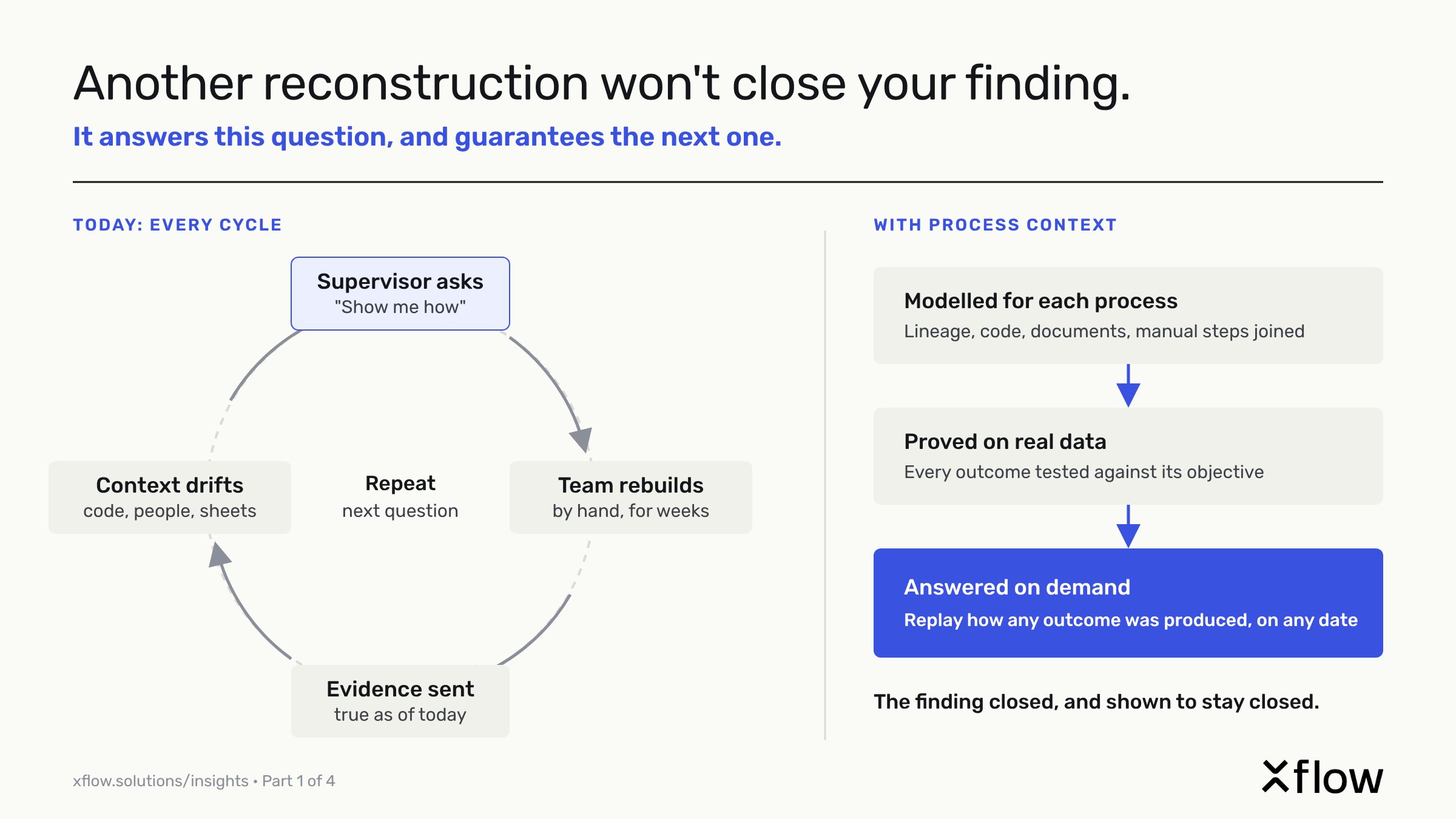
Another reconstruction won't close your finding
Rebuilding the evidence answers today's supervisor question. It does nothing for the next one.
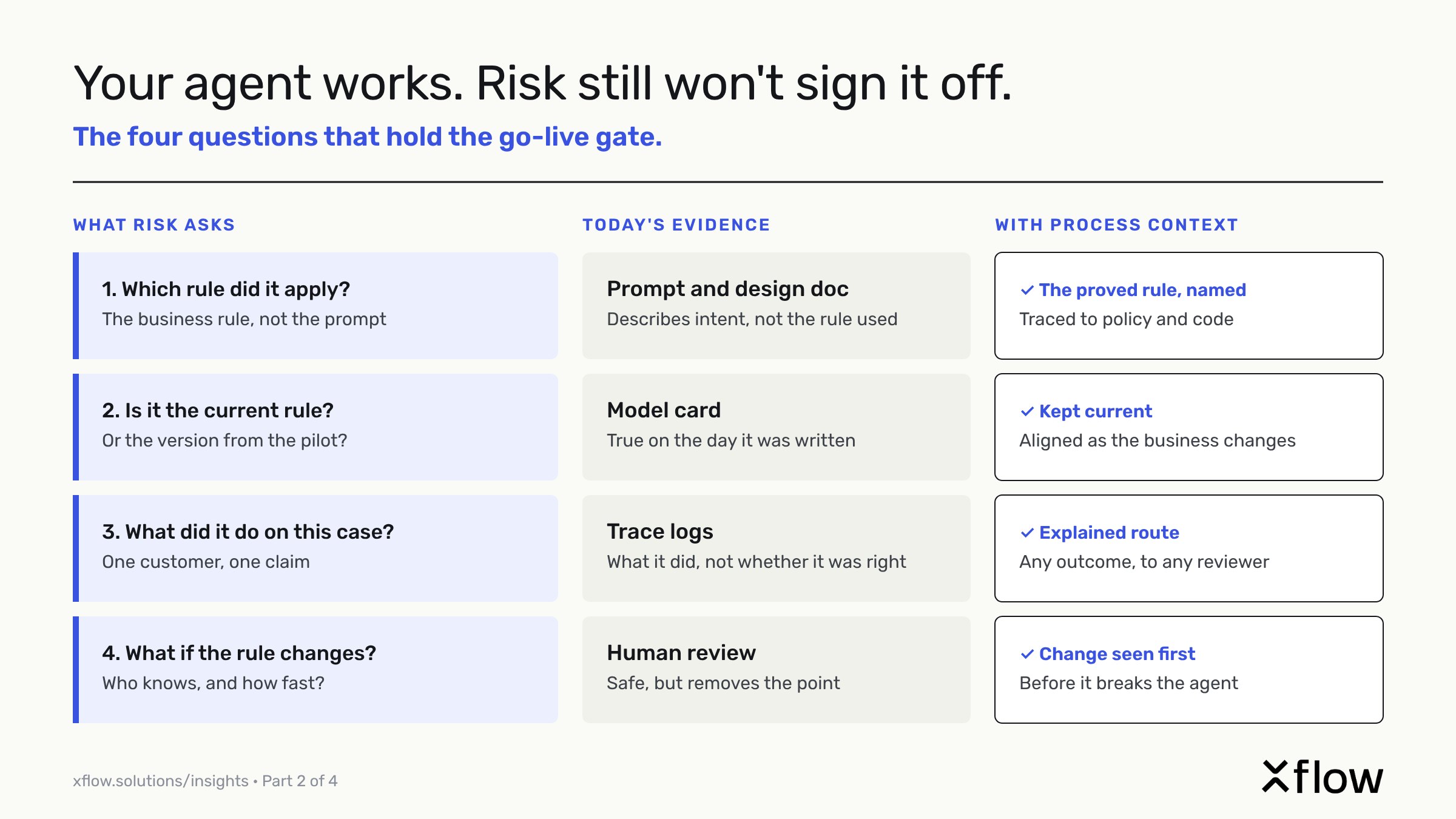
Your agent works. Risk still won't sign it off.
The go-live gate is not a model problem. It is a proof problem.
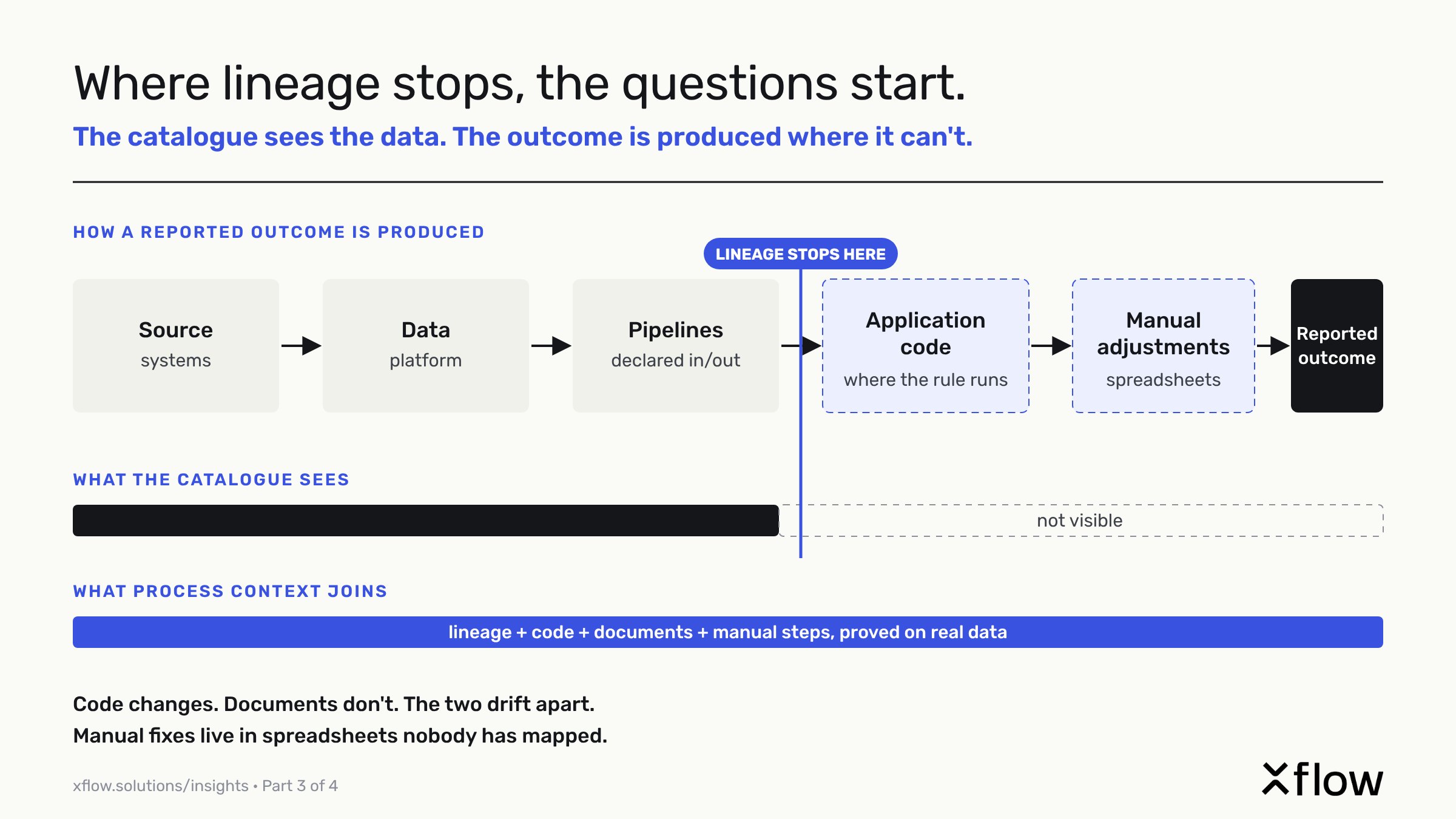
Where lineage stops, the questions start
The catalogue sees the data. The outcome is produced somewhere it cannot see.
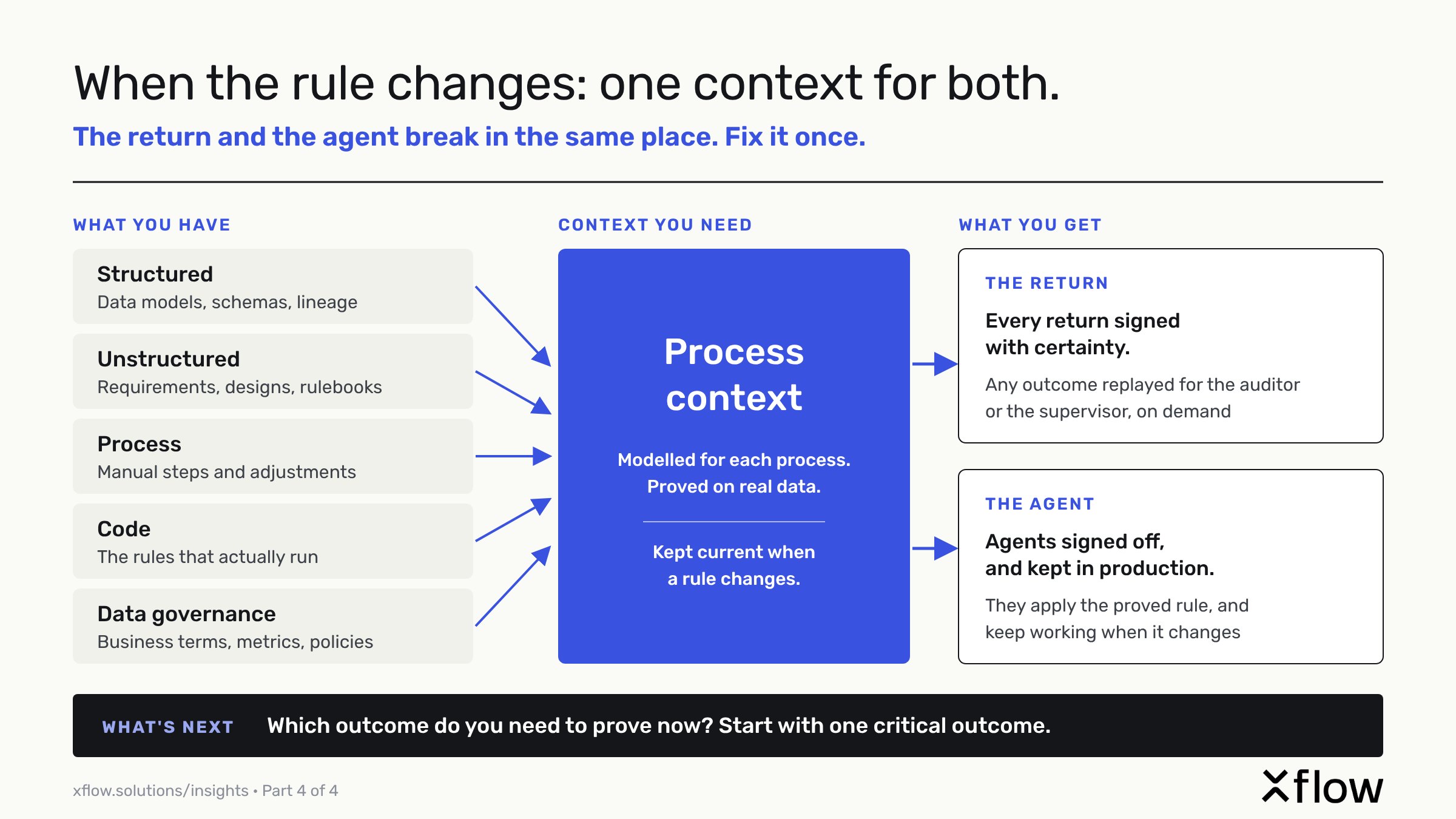
When the rule changes: one context for the return and the agent
The return and the agent break in the same place. They can be fixed in the same place.
In-depth guides
The BCBS 239 principles, and why banks still fall short of them
All 14 principles, what the ECB's 2024 Guide adds, and the one cause underneath most BCBS 239 shortfalls.
SS1/23 and SR 26-2: model risk management beyond the model
The PRA's five principles, what SR 26-2 changed and leaves out for AI agents, and where model risk actually sits.
Data lineage tools: the five types, where each stops, and how to choose
The five types of lineage tool, where each one stops, and eight questions to ask before choosing.
The regulatory reporting process: from reconciling figures to proving outcomes
Why errors of treatment pass every check, what supervisors expect, and how a reported outcome is proved.
Solvency II and IFRS 17 reporting: proving how each outcome was produced
QRTs, the SFCR and the IFRS 17 close: where the evidence breaks down between actuarial, finance and spreadsheets.
Quick reads
AI explainability in banking: explain the process, not just the model
Model explanations show why a score came out. Regulators increasingly ask how the outcome was reached, end to end.
Reconcile only when the same question gives two different numbers
Golden-source programmes assume one true number is waiting to be found. There isn't. The number depends on the question, so the question has to travel with it.
The code behind a regulatory outcome should be something the business can question
The business owns the regulatory outcome but rarely built the systems that produce it. Joining the code to the process gives accountable people a view they can interrogate.
Your data says what happened. Your catalogue says why. The process says how.
Entity and transaction data give the what and the when. Catalogues and policies give the why. The how, the process that turns a rule into a reported outcome, is the context agents need.
Know what a change will touch before you make it
Mapping business terms and rules across code repositories lets a change be traced across repositories, data and manual steps before a line is committed.
Context needs an objective, and only a process has one
Catalogues describe things. A process has an objective, an order and an output that gets examined, which is why context becomes usable at the level of the process.
Your data governance investment can do operational work
Banks and insurers already hold the definitions, lineage and ownership their processes depend on. The missing step is joining that estate to the process as it actually runs.
Regulatory reporting is a process, not a template
The template is only the endpoint. Supervisors ask how each outcome was produced, and the answer sits in the process behind it.
Agents remove the human interpreter, not the obligation
In every regulatory process someone quietly supplies the missing context. An agent can only do the same if that knowledge is captured as part of the process.
Cell-level lineage is the difference between explanation and proof
For risk figures, IFRS 17 disclosures and Solvency II provisions, the evidence sits at the level of the value, and the transformations usually sit in code.
Process mining shows what happened. Process context shows how it should run.
Event logs show the path work took. Process context adds the rules inside the code, the judgements in spreadsheets, and whether either matches policy.
Evidence should be produced by design, not reconstructed under pressure
Most regulatory evidence is assembled after the question arrives. Held as process context, it is there before anyone asks.
IFRS 17 needs judgement lineage, not another close checklist
IFRS 17 depends on traceable judgement: assumptions, methodology versions, CSM roll-forwards and the manual steps between actuarial and finance.
Which outcome do you need to prove now?
Start with one critical outcome. We’ll show you how it is produced today, where that differs from what is documented, and how to close the gaps.
Start with one critical outcome Back to top